How can universities make Geriatric Medicine visible, coherent and assessable within an existing undergraduate medical curriculum?
The GERI-CHARM Implementation Toolkit is a practical, adaptable guide for universities, medical schools and curriculum leaders seeking to introduce, strengthen or integrate Geriatric Medicine in undergraduate education. Developed through collaboration between Trinity College Dublin and the University of Barcelona, it brings together curriculum mapping, academic exchange, stakeholder engagement and collaborative educational design.
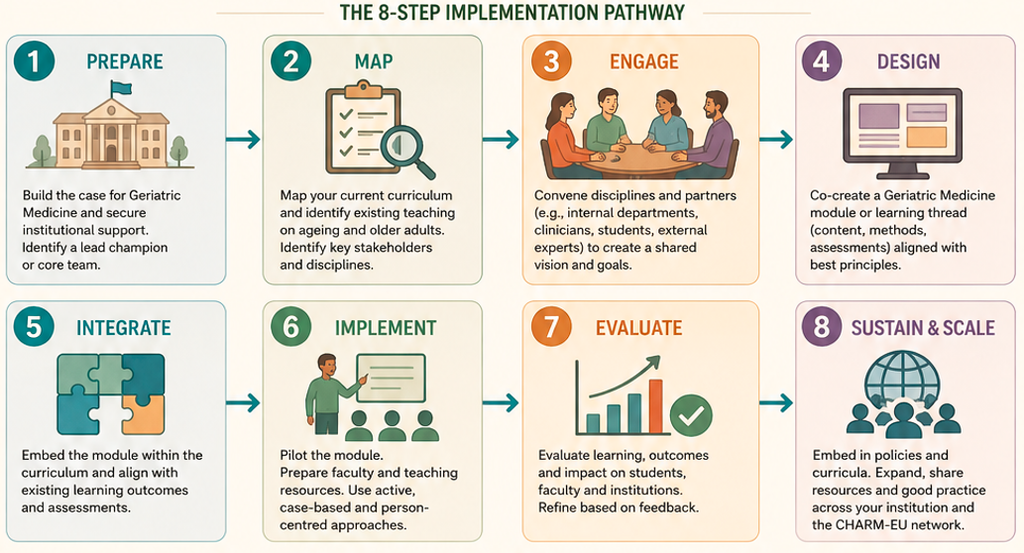
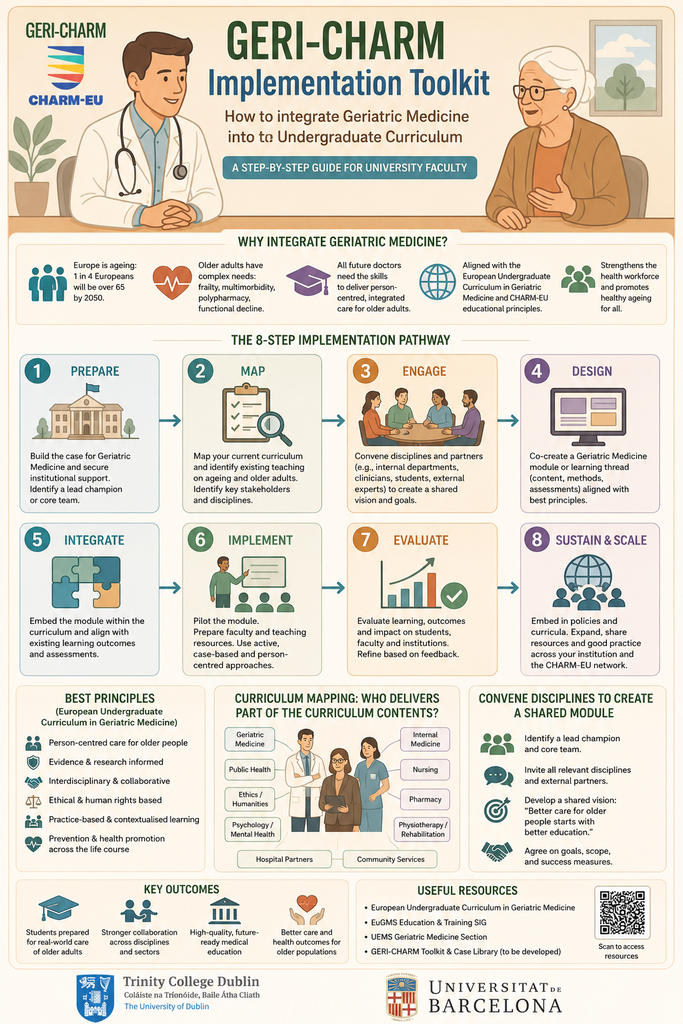
The Service Portfolio entry distils the toolkit into an eight-stage implementation pathway – Prepare, Map, Engage, Design, Integrate, Implement, Evaluate, and Sustain & Scale – with practical guidance for adapting the approach to local curricula.
Read more
Why this matters. Population ageing is reshaping medical practice across Europe. WHO/Europe projects that the population aged 60 and over in the WHO European Region will exceed 300 million by 2050. Future doctors in every specialty will routinely care for older adults with complex combinations of frailty, multimorbidity, cognitive impairment, polypharmacy, functional decline and palliative care needs.
An evidence-based starting point. Undergraduate exposure to Geriatric Medicine remains variable: it may be taught as a dedicated module, dispersed across other disciplines, or not explicitly identified. The European Undergraduate Curriculum in Geriatric Medicine was developed through international Delphi consensus and provides a common foundation for the knowledge, skills and attitudes expected of medical graduates. GERI-CHARM uses this evidence base as a practical starting point for curriculum implementation.
The GERI-CHARM collaboration. GERI-CHARM was stablished through CHARM-EU’s seed-funding framework, CHARM-ED, as a collaboration between Trinity College Dublin and the University of Barcelona. The partners have mapped and compared curricula, exchanged teaching materials, and worked with academic, clinical and professional stakeholders, including Hospital Clínic Barcelona, the European Geriatric Medicine Society (EuGMS), the UEMS Geriatric Medicine Section and CHARM-EU partners. The July 2026 Barcelona exchange focused on making geriatric competencies more visible, integrated and assessable and on developing the toolkit for potential use across the wider CHARM-EU Alliance.
What the toolkit provides. It helps institutions build the case for change and leadership; map current teaching, assessment, gaps and duplication; convene disciplines and stakeholders; choose a standalone, transversal or hybrid curriculum model; define learning outcomes; design challenge-based and case-based teaching; assess learning; pilot and evaluate; and embed sustainable governance. Ready-to-use tools include curriculum and discipline mapping templates, module planning forms, a stakeholder workshop agenda, pilot evaluation questions, and quality-assurance and sustainability checklists.
Designed to be adaptable. Universities can use the toolkit whether Geriatric Medicine already has a dedicated module, is partially distributed across disciplines, or is not yet visible. The Service Portfolio uses the simpler eight-stage pathway shown in the infographic; the full toolkit provides the detailed sub-steps, templates and examples behind each stage.
A CHARM-EU fit. The toolkit complements CHARM-EU educational principles, particularly challenge-based, transdisciplinary, student-centred and clinically situated learning. Geriatric Medicine offers an authentic context for addressing a complex societal challenge while strengthening communication, teamwork, ethical reasoning and systems thinking.
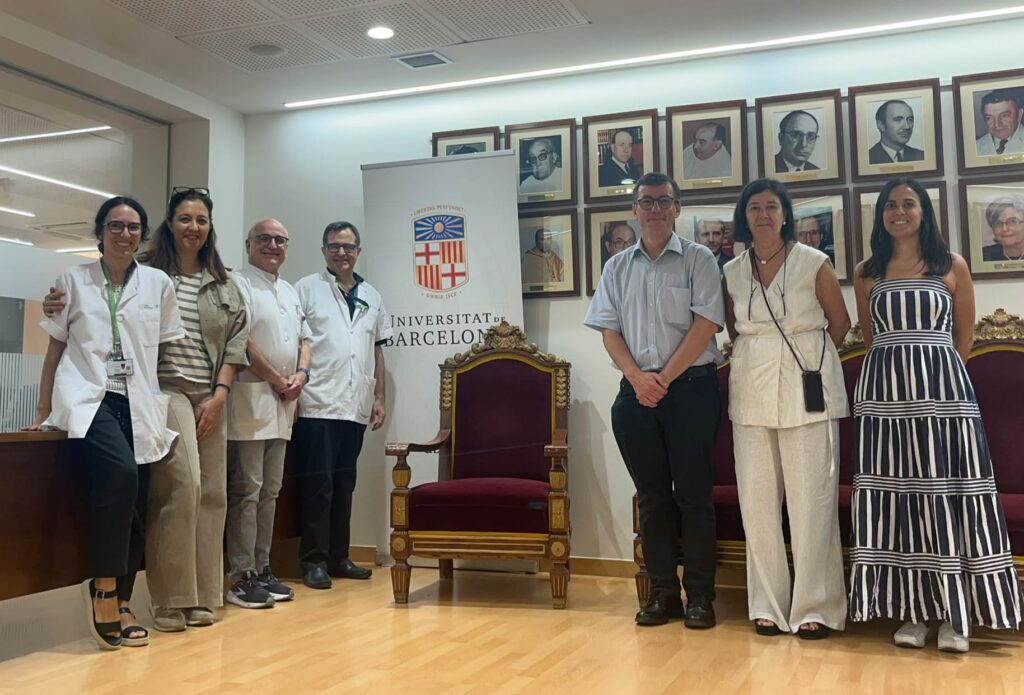
GERI-CHARM collaboration visit at the University of Barcelona, July 2026
SOMETHING FOR YOU TOO? EXPLORE THE OPPORTUNITIES!
The following resources provide background, practical guidance and reusable CHARM-EU tools for adapting the GERI-CHARM approach.
- GERI-CHARM: University of Barcelona and Trinity College Dublin collaboration – official CHARM-EU project news and context.
- European Undergraduate Curriculum in Geriatric Medicine – European consensus curriculum and minimum learning expectations.
- CHARM-EU Pedagogical Guidelines – educational principles and implementation guidance.
- CHARM-EU Teaching and Learning Strategies Handbook
- Challenge-based learning: a workshop template – reusable activity plan for applying challenge-based learning.
- Joint curriculum design: a hackathon template – practical support for multidisciplinary and inter-institutional co-design.
- Effective feedback: a workshop template – a reusable approach to strengthening feedback and evaluation practice.
WOULD YOU LIKE TO INTEGRATE GERIATRIC MEDICINE INTO YOUR CURRICULUM? SEE OUR GUIDES!
Use the pathway flexibly. Institutions do not need to start from zero: curriculum mapping is intended to reveal what is already being taught, then make relevant content more coherent, visible and assessable.
The full GERI-CHARM Implementation Toolkit contains the detailed templates, example learning outcomes, challenge-based cases, assessment options and evaluation tools that sit behind this summary pathway.
| Step | Action | Who Should Be Involved? | Resources / Support |
| 1. PREPARE | Build the case for change, appoint an academic/clinical champion, form a core working group and agree the route to curriculum approval. | Geriatric Medicine lead; curriculum/programme leadership; medical education; student representative. | European Undergraduate Curriculum; CHARM-EU Pedagogical Guidelines. |
| 2. MAP | Review the curriculum to identify where ageing and older-adult content is taught, how it is assessed, and where gaps or duplication exist. | Curriculum office; module and discipline leads; assessment leads; students. | GERI-CHARM curriculum mapping and discipline mapping templates. |
| 3. ENGAGE | Convene disciplines and partners to agree priorities, learning outcomes, responsibilities and measures of success. | Geriatrics; Medicine; Primary Care; Psychiatry/Neurology; Pharmacy; Rehabilitation; Palliative Care; Nursing/AHPs; students; clinical partners. | GERI-CHARM stakeholder workshop agenda; Joint Curriculum Design hackathon template. |
| 4. DESIGN | Choose a standalone, transversal or hybrid model; co-design core outcomes, teaching activities and assessment. | Working group; educationalists; module leads; assessment leads. | European Undergraduate Curriculum; Teaching and Learning Strategies Handbook. |
| 5. INTEGRATE | Embed agreed content across existing modules and placements and align teaching with programme outcomes and assessment. | Module leads; curriculum committee; placement coordinators. | GERI-CHARM shared module planning form; CHARM-EU Pedagogical Guidelines. |
| 6. IMPLEMENT | Pilot the module or learning thread, prepare faculty, use authentic cases and clinical contexts, and gather implementation feedback. | Teaching faculty; clinical educators; students; placement and support staff. | GERI-CHARM case/module materials; Challenge-based Learning workshop template. |
| 7. EVALUATE | Measure reach, learning, attitudes, curriculum integration and faculty engagement; review feedback and refine. | Students; faculty; quality/evaluation teams; curriculum leads. | GERI-CHARM pilot evaluation form and evaluation framework; Effective Feedback workshop template. |
| 8. SUSTAIN & SCALE | Secure governance, timetable and assessment ownership; review annually; build a resource repository; share practice through CHARM-EU and professional networks. | Curriculum and institutional leadership; academic lead; CHARM-EU partners; professional societies. | GERI-CHARM quality-assurance and sustainability checklist; Teaching and Learning Strategies Handbook |