
How can students turn the scientific knowledge they acquire at university into concrete action for society? SEED-ED, a collaborative initiative between the University of Montpellier and Trinity College Dublin, invites students to tackle this question through plants and insects, from living collections in botanical gardens to fossils documenting ecosystems millions of years ago. By combining challenge-based learning, science communication and outreach, the project encourages students to use their expertise to engage with contemporary biodiversity challenges.
Read more
The project’s seed
The project grew out of a collaborative initiative between the University of Montpellier and Trinity College Dublin. Artemis Anest (Assistant Professor at the University of Montpellier), while teaching a specialised course on Plant Architecture, a botanical approach developed in Montpellier notably through the work of botanist Francis Hallé, noticed that students were increasingly concerned about how they could apply the knowledge they were acquiring at university to real-world challenges, such as biodiversity conservation. Artemis decided to show students that they do not need to wait until they enter professional life to make a contribution. Even at a small scale, they can already take action and use their scientific knowledge to help build the future they want to see. With her colleague Thibault Durieux, then a senior PhD student at Trinity College Dublin, she launched a CHARM-EU project with one central aim: to support students in engaging with society and using their scientific knowledge as a lever for biodiversity conservation. Artemis and Thibault developed two parallel initiatives at the University of Montpellier and Trinity College Dublin, each rooted in their own scientific expertise and that of their students.
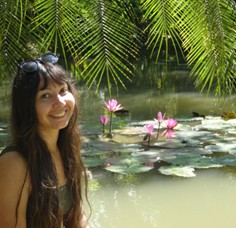
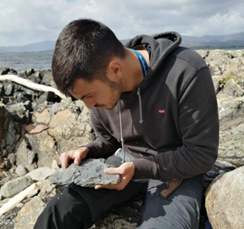
Rooting into fossil plants…
At Trinity College Dublin, Thibault brought together Master students, PhD students and postdoctoral researchers in palaeobotany to explore how fossil collections could be made accessible and meaningful to a general audience, and how fossils could help people understand today’s ecological challenges. After exploring a range of possible formats, the team of young palaeobotanists settled on a creative but achievable idea: an escape game. Through fossils, participants would learn how scientists reconstruct past geological periods, investigate why organisms disappeared, and discover how major environmental changes have repeatedly reshaped both the Earth’s surface and its living organisms. Rather than simply presenting fossils as objects from the distant past, the activity turns them into evidence that can help us understand how ecosystems respond to environmental change.
…and expanding to modern plants
In Montpellier, students enrolled in the Plant Architecture course use the concepts learned in class to identify a scientific or management challenge related to a plant growing in Montpellier’s botanical garden. Working in pairs, students choose a question connected to their own professional interests: “How can the evolutionary history of this plant help us protect its future?” ; “Could this species be a suitable urban tree under future climate conditions?” After mobilising their new knowledge to answer the question, they face a second challenge: translating their scientific analysis into content that can be understood by visitors with no specialist background. Their final texts are intended to be permanently displayed alongside the plants in Montpellier’s botanical garden.
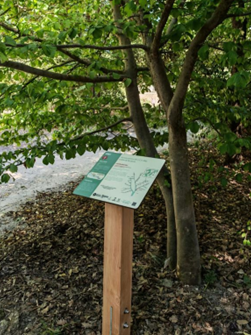
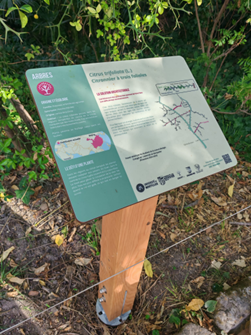
Two educational panels created by students from the University of Montpellier and permanently displayed alongside the plants they studied in the Montpellier Botanical Garden.
Turning the results of a scientific or management question into content that can genuinely engage a general audience is not straightforward. To meet this challenge, students had the opportunity to work with professionals experienced in science communication. They notably received the support of Jean-François Fauveau, Deputy Head of Horticultural Operations and Graphic Designer at Montpellier’s Botanical Garden, who works on events and communication at Montpellier’s botanical garden. He helped the students make their messages clear, concise and accessible to the broadest possible audience.
Branching out across CHARM-EU
SEED-ED brought the Montpellier and Dublin teams together through an online webinar organised by Artemis and Thibault. Students from both universities presented their projects, compared their approaches and discussed how very different scientific objects, from living plants to fossil collections, could be used to engage wider audiences with biodiversity and environmental change. The webinar was opened to the wider CHARM-EU Alliance, extending the exchange beyond the students directly involved in the project. Thanks to this opening, it also became an opportunity for other students to discover SEED-ED and the different ways they could take part. This first cross-university exchange had a direct legacy, as several students who encountered the project through the webinar are now starting new associated projects, which will continue and expand the initiative in 2027.
Spreading the seeds: students sharing their work internationally
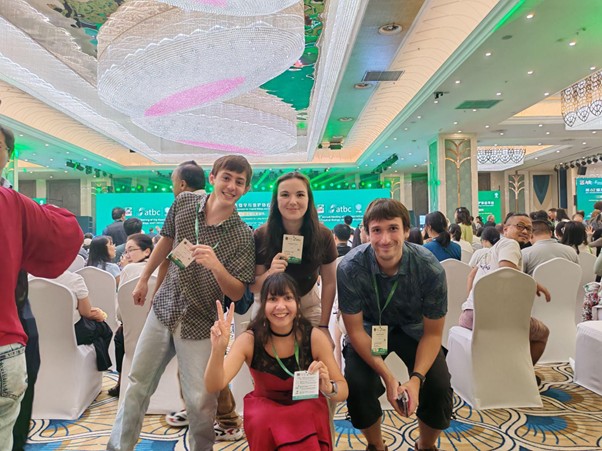
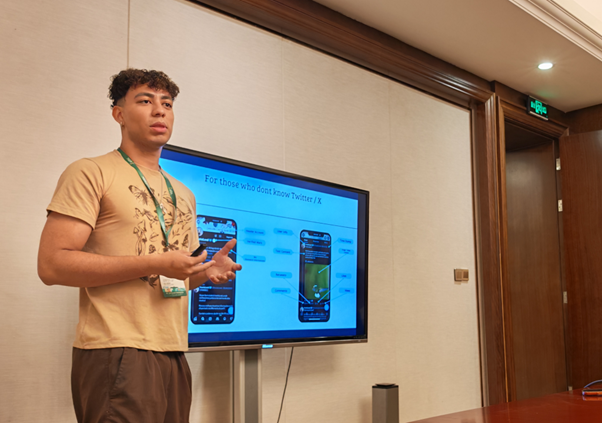
SEED-ED did not stop at the borders of the two partner universities. With support from CHARM-EU, students were also given the opportunity to share their work internationally. Four students from Montpellier and Dublin involved in SEED-ED received support to present their work at the 62nd Annual Meeting of the Association for Tropical Biology and Conservation (ATBC 2026) in Jinghong, China. Two Montpellier students received additional support from the French Embassy in China and the CAS-CNRS Sino-French Virtual Institute for Biodiversity. They participated in a workshop organised by Artemis entitled “Education and outreach initiatives for tropical biodiversity: a collaborative hands-on session”, which brought together scientists from around the world to exchange ideas and practical experience on how scientific knowledge can be translated into concrete action for biodiversity. For the students, this meant moving from being participants in a university course to becoming contributors to an international discussion on science, education and biodiversity outreach.
The future seeds
Thanks to CHARM-EU support, the initiative also attracted the attention of other scientific and conservation organisations. The Xishuangbanna Tropical Botanical Garden and the British Ecological Society, through the Journal of Applied Ecology and Methods in Ecology and Evolution, supported a workshop that allowed SEED-ED students to visit the botanical garden and explore first-hand how research, conservation, education and public engagement can be brought together. The project has already begun to generate new collaborations beyond its original educational objectives. Exchanges initiated through SEED-ED have contributed to the development of a scientific article currently being prepared for the Journal of Applied Ecology. What started with a simple question, how can students use what they learn to contribute to society?, has therefore grown into a network connecting students, researchers, botanical gardens and international scientific organisations. From fossil plants to living collections, SEED-ED shows that learning science can also mean learning how to share it, question it and put it into action.
SOMETHING FOR YOU TOO? EXPLORE THE OPPORTUNITIES!
Would you like to contribute to SEED-ED?
Do you have a favourite taxonomic group you would like to use to connect students and the public? Botanical, fossil or other biodiversity collections you would like to showcase within your own institution? Or would you like to connect your students with others across the CHARM-EU Alliance?
Get in touch with us!
Students interested in biodiversity, science communication or outreach are also welcome to join SEED-ED and develop their own projects with peers from other institutions! SEED-ED is designed to grow through new students, collections, disciplines and institutional collaborations.
List of resources
- SEED-ED dedicated website (work in progress) : https://arteanest.github.io/website/outreach/seed-ed/index.html
Some student’s LinkedIn posts about SEED-ED:
- Panels in the Botanical Garden of Montpellier : https://lnkd.in/p/eeCBSrcW
- Matheus Sanches’s (PhD student at Trinity College Dublin) post on his mobility to ATBC 2026 : https://lnkd.in/p/d8G37tmp
- Raphaelle Aubry’s (Master student at the University of Montpellier) post on his mobility to ATBC 2026 : https://lnkd.in/p/dpRh8QMg
WOULD YOU LIKE TO CONNECT STUDENTS AROUND BIODIVERSITY ACROSS INSTITUTIONS? SEE OUR GUIDES!
| Step | Action |
| 1. Start locally. | Gather students interested to work on a biodiversity-related question linked to a collection, taxonomic group or scientific topic available in their institution. |
| 2. Turn a scientific question into something for the public. | Let students investigate the question using their academic knowledge, then challenge them to transform what they learned into an accessible outreach format, such as an educational panel, game or other public-facing resource. |
| 3. Open the exchange. | Invite the wider CHARM-EU community to join the discussion. This can help new students and colleagues discover the initiative, contribute their own expertise and develop new associated projects. |
The key ingredients are simple! Student ownership, a common biodiversity theme and dedicated time for cross-institutional exchange.