Visibility, Resilience and Clarity: Advanced Strategies for Institutional Science Communication
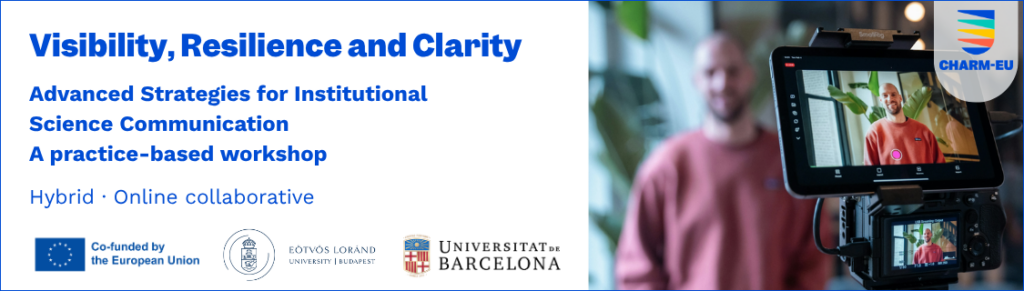
Interested in making science visible and easy to understand?
Organised by Eötvös Loránd University Budapest and the University of Barcelona (UB), this hands-on workshop equips you with key tools to communicate research in digital environments. You will learn to turn complex ideas into engaging formats (podcasts, reels, or posters), boost web visibility (SEO/AI), and counter misinformation using prebunking strategies. Work in an international, multidisciplinary team to solve a real-world institutional communication challenge!
Basic course details
💻Hybrid / Online collaborative (short, intensive learning activity).
📅2 live online sessions
- 1 October 2026, 15:00–18:45
- 12 November 2026, 15:00–18:45
- + a 6-week online teamwork period in between
|
Target audience |
Undergraduate students from any field of study (transdisciplinary: sciences, social sciences, humanities, etc.). |
|
Spots available |
20 spots (10 students from ELTE Budapest, working together with 10 students from the UB). |
|
Language of instruction & teamwork |
English (due to the international nature of the collaboration). |
|
Methodology |
Challenge-Based Learning (CBL) and intercultural teamwork. |
|
Location |
ELTE Faculty of Humanities (ELTE BTK)
R Building, Room 246
Faculty of Information and Audiovisual Media (UB)
HALC Room
|
|
Sign-up form |
ELTE: internal sign-up via NEPTUN (internal system)
|
|
Course contact (UB) |
ELTE: Zoltán Somody (somody.zoltan@kancellaria.elte.hu) Jorge Franganillo (franganillo@ub.edu) |
Key objectives and content
This workshop guides students through the complete lifecycle of a scientific message across four main pillars:
- Institutional and science communication. Introduction to the most popular formats to reach young audiences (short videos, podcasts, reels, and popular science articles).
- Algorithmic visibility and SEO strategy. Analysis of how search engines and AI summary tools (such as Google Discover or AI Overviews) filter information, helping quality research stand out against junk content.
- Narrative Resilience through Prebunking. Designing proactive strategies (cognitive inoculation) to anticipate and neutralise misinformation patterns and science denialism before they spread.
- Scientific Accessibility and Plain Language. Applying the international plain language standard (ISO 24495-1) and guidelines for science writing (ISO 24495-3) to ensure scientific accuracy remains clear and accessible to everyone.
Methodology and course structure
- Session 1: professional foundations (1 October 2026). Introduction to core concepts, analysis of real case studies and presentation of the team challenge.
- Collaborative teamwork phase (6 weeks). Students work in 4 mixed teams (UB–ELTE) to create a specific communication campaign or product based on a real research finding.
- Session 2: project presentations (12 November 2026). Final pitch and presentation of the group projects (campaign proposal, podcast script, promotional video, etc.).
Teaching team
The course will be mentored and guided by professionals in institutional and academic communication:
- Zoltán Somody (ELTE) – Press and Communications Officer.
- Jorge Franganillo, PhD (UB) – Lecturer and expert in content usability and plain language.
- Carlos Lopezosa, PhD (UB) – Lecturer and expert in algorithmic visibility and SEO strategy.
- Lydia Sánchez, PhD (UB) – Lecturer and expert in narrative resilience and misinformation (prebunking).
Benefits for students
Key advantages:
- Flexible international experience: internationalisation at home. Collaborate directly with students from Budapest (Hungary) in a multicultural online environment without travel costs or logistics.
- Transdisciplinary profile. Open to all degrees. No prior background in communication or science is required. The project thrives on diverse perspectives from health sciences, engineering, social sciences, and humanities.
- In-demand practical skills. Learn digital positioning (SEO, AI, GEO), how to counter fake news/misinformation, multimedia creation, and clear writing — key transversal skills that boost any CV.
- Upon completion of the course, a CHARM-EU edubadge on “Advanced Strategies for Institutional Science Communication” will be granted.