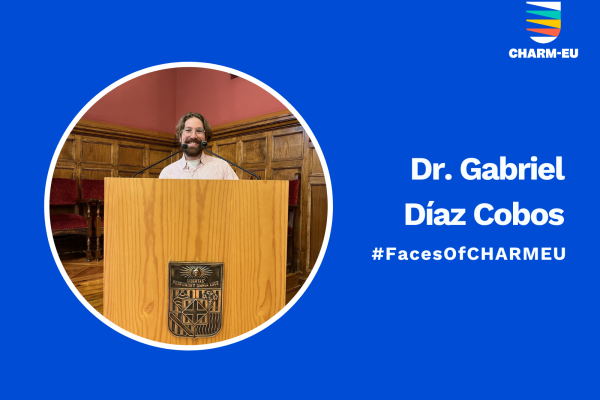
For Dr. Gabriel Díaz Cobos, a lecturer at the University of Barcelona, educational innovation is rooted in the connection between movement, cognition, and learning. Through his work in CHARM-EU, he is building bridges across institutions to develop collaborative approaches to transversal skills in teacher education.
Dr. Gabriel Díaz Cobos – University of Barcelona
Role: Lecturer at the Faculty of Education at the University of Barcelona. Project Coordinator of the CHARM‑ED funded project: “Active Schools and Physical Education as a Driver of Transversal Skills in Initial Teacher Education: A Joint UB & ELTE Challenge‑Based Educational Initiative.”
Could you introduce yourself?
My name is Gabriel Díaz Cobos, and I am a lecturer at the Faculty of Education at the University of Barcelona. My teaching and research focus on the relationship between movement, cognition, and learning, particularly in early childhood and primary education contexts.
I currently coordinate initiatives related to motor skills, cognition, and educational innovation within the University of Barcelona, including the research group “Motor Skills, Cognition and Education” and the IDP-UB working group “Motor Skills, Cognition, Childhood and School”, among others. Many of these initiatives are developed in collaboration with my colleague Dr. Eric Roig, with whom I also share the UB-ELTE CHARM-EU project.
How did you first get involved in CHARM-EU?
My connection with CHARM-EU stems precisely from this desire to build bridges between research, teaching, and internationalisation. I see the university as a space for open collaboration, and CHARM-EU offers an extraordinary opportunity to transform shared interests into real projects across European institutions.
What attracted me most was the possibility of establishing academic collaborations that go beyond short-term mobility, creating genuine spaces for shared work. From the very beginning, I saw it as an excellent opportunity to connect our research lines on movement, education, and learning with other European teams.
When I became familiar with the work carried out at ELTE (Eötvös Loránd University, Budapest), I immediately identified a very interesting complementarity with the lines we develop at the University of Barcelona.
From there, an academic dialogue began which, with the support of CHARM-EU, has evolved into a concrete project.
Your CHARM-ED project
Could you briefly summarise the objectives of your CHARM-ED project?
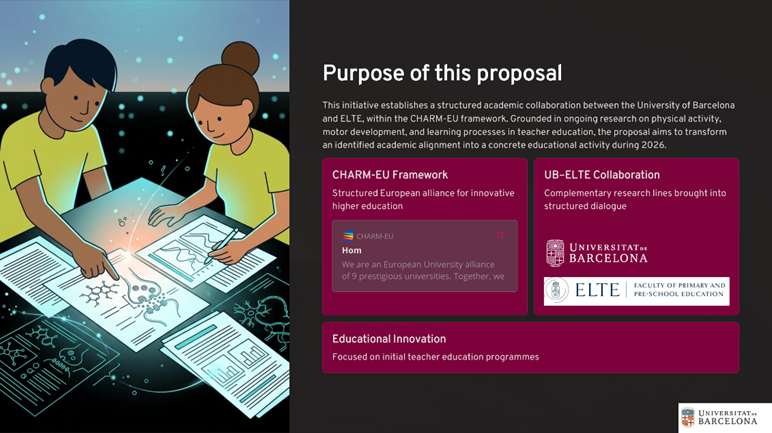
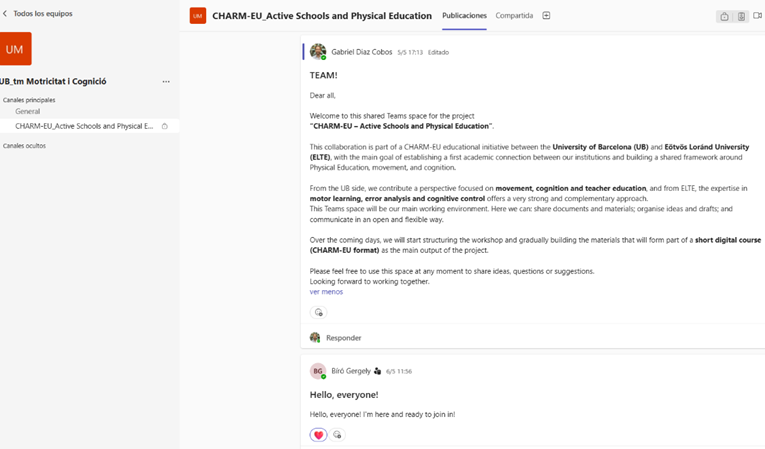
Our project, developed jointly by the University of Barcelona and ELTE, explores how physical education and the active schools model can contribute to the development of transversal competencies in initial teacher education.
During 2026, we will organise a joint workshop in Budapest to build a shared framework between both universities. Based on this work, we will develop an open digital course within CHARM-EU and a joint academic proposal that will lay the foundation for future teaching and research initiatives.
Which CHARM-EU educational principles influence your project the most, and why?
I would highlight four in particular.
- First, Challenge-Based Learning, as the entire project revolves around a real educational challenge: how to harness the pedagogical potential of physical education to develop transversal competencies in future teachers.
- Second, interdisciplinarity. Our project connects physical education, learning sciences, cognitive psychology, motor development, and teacher education.
- Research-Based Learning is also highly relevant, as we aim to translate available scientific evidence into concrete proposals applicable in real educational contexts.
- Finally, the project strongly aligns with CHARM-EU’s focus on transversal skills, which we consider central to the training of future educators.
What is the added value of interinstitutional and interdisciplinary collaboration?
The main value is that it pushes us to move beyond our own perspectives, explore others, build academic and scientific knowledge bridges, and mutually enrich ourselves through the new discourse generated. When different perspectives engage in dialogue, new questions, research opportunities, and educational proposals emerge, things that would hardly arise when working in isolation.
Vision and future
What impact do you foresee for your joint project?
In the short term, we expect to achieve three concrete outcomes:
- First, to establish a stable academic collaboration between the University of Barcelona and ELTE.
- Second, to develop an open digital educational resource for sharing within the CHARM-EU community.
- Third, to build a shared conceptual framework on physical education, active schools, and transversal competencies in teacher education.
However, the most interesting impact will likely come later. Both our colleagues at ELTE and we see this initiative as a first step. We believe it can open the door to future research projects, mobility programmes, shared training experiences, collaborations with schools, and eventually the development of more ambitious European educational programmes.
How do you see the role of CHARM-EU in supporting educational innovation and collaboration?
I believe the greatest value of CHARM-EU is that it makes international collaboration tangible.
We often speak about internationalisation, cooperation, or educational innovation in abstract terms. CHARM-EU provides the mechanisms to turn those ideas into real professional relationships between people and institutions.
In our case, it has enabled researchers and educators from Barcelona and Budapest to connect around shared interests and develop a project with concrete outcomes.
If I had to summarise it in one sentence, I would say that CHARM-EU does not just create projects; it creates academic communities capable of learning together, building shared knowledge, and addressing common educational challenges from a genuinely European perspective.
The CHARM-ED Funding Call is an initiative that incentivises collaborative educational innovation projects across the alliance. It provides small-scale seed funding for academic and professional staff to collaboratively develop innovative educational activities aligned with CHARM-EU educational principles.