CHARM-ED Projects
The CHARM-ED Call offers funding to support the development, enhancement, or redesign of higher education and lifelong learning activities across the CHARM-EU Alliance.
More than 50 academics and professionals from over 40 disciplines will collaborate across nine universities, advancing CHARM-EU’s shared mission to reimagine higher education. The selected projects exemplify CHARM-EU’s commitment to educational innovation and collaboration. They were chosen for their clear alignment with CHARM-EU’s educational vision and potential to create meaningful impact at both institutional and alliance levels. Read more about the selected projects below, and keep an eye on our events page for updates. The funding for this call was provided through the CHARM8 project.
SEED-ED: Challenge-based learning from botanical gardens to fossil records: students engaging science with society
More details
Dr Artemis Anest, Assistant professor of Botany, University of Montpellier
Thibault Durieux, PhD candidate in Paleobotany, Trinity College Dublin
This project is a transdisciplinary, student-centered educational initiative combining biodiversity research, materials science, and public engagement. Its main goal is to explore innovative ways to disseminate knowledge and promote the value of botanical collections from botanical gardens, herbaria, fossil records, and other plant materials.
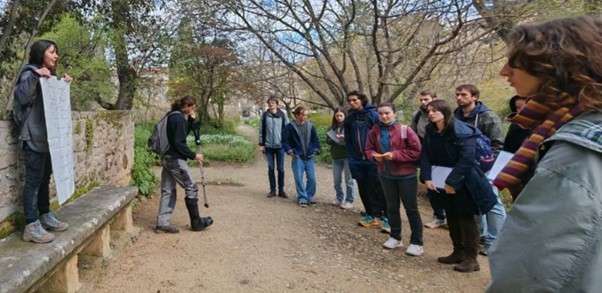
The first steps of the project will involve, on one hand, the creation of educational panels, and on the other hand, the development of a plan to highlight fossil collections. Bachelor’s students in ecology will define a scientific question and produce educational panels to be displayed at the Botanical Garden of Montpellier. In parallel, students at Trinity College Dublin will engage in discussions and design outreach initiatives centered on fossil collections. A joint webinar bringing together students from Montpellier and Trinity College will connect their respective experiences and advance discussion on how to extend this approach to other collections and promote international collaboration.
The project will encourage participants’ interdisciplinary collaboration skills and science communication competencies. The public exhibition of the panels at the Botanical Garden of Montpellier, along with future outreach initiatives developed through these discussions, will help raise awareness of plant biodiversity, conservation challenges, and the value of all types of biological collections.
Call for contributions
We invite contributions for a workshop/open session at ATBC 2026 entitled:
“Education and outreach initiatives for tropical biodiversity: a collaborative hands-on session.”
We are seeking researchers and students at all career stages to present outreach initiatives related to tropical biodiversity and conservation. Whether your initiative is ongoing, completed, or still at the idea stage, you are warmly welcome to present it and exchange with others during the session (5-10 minutes interactive presentation with the audience).
Please note that the session is limited to 40 participants, so we kindly ask you to register if you wish to contribute.
We look forward to welcoming you in Jinghong on June 28, 2026. More information is available here.
For any questions, please feel free to contact the session chair:
Artemis Anest: artemis.anest@umontpellier.fr
Registration form:
GERI-CHARM: Enhancing Undergraduate Geriatric Medicine Education through CHARM-EU Collaboration and bilateral exchanges between Trinity College Dublin and the University of Barcelona
More details
Prof. Román Romero-Ortuño, Professor of Ageing Medicine and Frailty, Trinity College Dublin; Consultant Physician, St James’s Hospital, Dublin; Representative for Education and International Affairs, Irish Gerontological Society; Director of Education and Training, European Geriatric Medicine Society (EuGMS)
Prof. Alfonso López Soto, Associate Professor of the Department of Medicine, University of Barcelona
Dr. Juan Manuel Pérez Castejón, Head of the Department of Geriatric Medicine, Hospital Clínic Barcelona
Dr. Maria Victoria Farré Mercadé Member of the Executive of the Catalan Society of Geriatrics and Gerontology; Board Member of the European Union of Medical Specialists – Geriatric Medicine Section
Dr. Marta Arroyo Huidobro, Resident of the Department of Geriatric Medicine, Hospital Clínic Barcelona; member of PROGRAMMING (PROmoting GeRiAtric Medicine in countries where it is still eMergING) COST Action
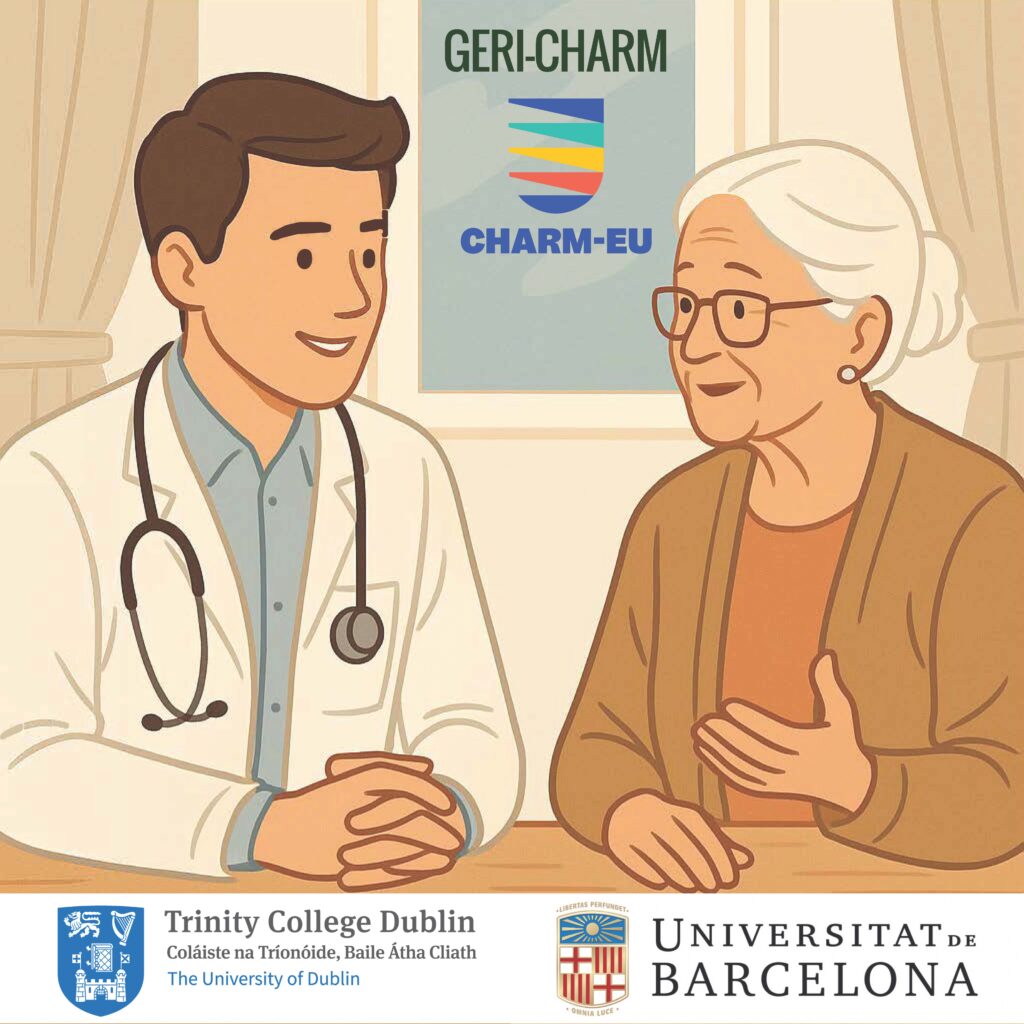
Europe’s population is ageing rapidly, yet training on how to care for older adults varies widely between countries. The GERI-CHARM project brings together Trinity College Dublin and the University of Barcelona to strengthen undergraduate teaching in Geriatric Medicine through collaboration, innovation, and academic exchange.
The project will host academic summits and faculty visits enabling educators to share teaching methods and co-develop a modern, challenge-based learning toolkit. This toolkit will be built on the principle of transversality across relevant disciplines and will focus on real-world issues such as frailty, multimorbidity, and healthy ageing, while ensuring alignment with the principles of the European Undergraduate Curriculum in Geriatric Medicine.
The module template will be co-created with a wide range of stakeholders, including students, clinicians, and professional societies, and disseminated through the CHARM-EU network, allowing other partner universities to adopt and adapt the shared resources for integrating Geriatric Medicine into their curricula.
Partnerships with hospitals and European professional bodies will ensure that GERI-CHARM’s teaching toolkit reflects current clinical practice and align with European standards. Through these collaborations, the project will help prepare future doctors to deliver compassionate, effective care for Europe’s ageing population while fostering lasting international cooperation and innovation in medical education.
Developing Hybrid and Transnational Modules in Citizen Science and Science Communication
More details
Joseph Roche, Trinity College Dublin
Josep Perello, University of Barcelona
Isabelle Bonhoure, University of Barcelona
Saskia Stevens, Utrecht University
Roger Strand, University of Bergen
Thierry Brassac, University of Montpellier
Mia Åkerfelt, Åbo Akademi University
Laszlo Robert Zsiros, Eötvös Loránd University
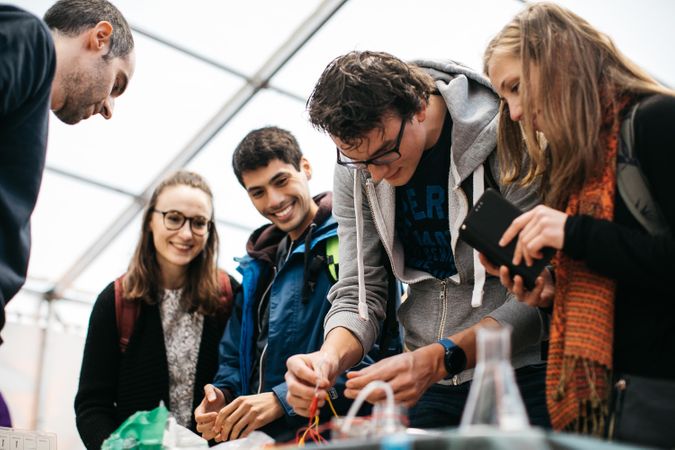
This project is opening up two Master’s level modules from Trinity College Dublin to students across the CHARM-EU university alliance. The modules focus on two interdisciplinary and connected topics: Citizen Science (where public audiences and scientists contribute to research) and Science Communication (which explores how to engage audiences to strengthen the science-society relationship). By updating these modules to become more flexible and hybrid in format, the modules will become more open and accessible. Students will learn core material online at their own pace and then come together in dynamic, international online workshops to collaborate on real-world challenges. Working with experts from across the CHARM-EU network and leading European organisations, this project aligns with the principles of CHARM-EU. The modules will equip students with the green, digital, and communication skills needed to tackle society’s biggest challenges, all while building a network of peers from different countries and cultures.
Activate your learning!
More details
Dr. Ana Belén Cano Hila, Professor of Sociology. University of Barcelona.
Dr. Montserrat Simó, University of Barcelona
Dr. Isabel Lausberg, Professor of Business. Ruhr West University of Applied Sciences.
Dr. Julia Thalmann, Professor of Business, Retail & E-Commerce. Ruhr West University of Applied Sciences.
Dr. Alexander Arenas Canon, Pedagogical Engineer and Trainer. University of Montpellier.
Klara Schneider, Educationalist. Ruhr West University of Applied Sciences.
Dr. Celine Avenel, Lecturer in the Education Sciences department at Université Paul Valéry-Montpellier 3, University of Montpellier.
Dr. Jean-Patrick Respaut, Head of Service Commun de Soutien à l’Innovation Pédagogique (SCSIP). University of Montpellier.
Dr. Karla Berrens, Professor of Sociology. Universtiy of Barcelona.
Dr. Cristina López, Professor of Sociology. Universtiy of Barcelona.
Dr. Marina Elias, Professor of Sociology. Universtiy of Barcelona.
Active methodologies for meaningful, reflective and professional teaching & learning in Higher Education” is a CHARM-EU joint course for university educators and PhD students with teaching responsibilities. It introduces student-centred pedagogies such as project-based learning, service-learning, gamification, and design thinking and supports participants in integrating these methods into their teaching practice. Active methodologies encourage student engagement, leading to better knowledge retention and the development of critical skills. The course develops educators’ skills for redesigning classroom dynamics, thereby contributing to improved educational quality.
Generative AI is integrated as a creative and reflective tool, supporting participants to design scenarios, prototype learning activities, and critically evaluate outputs, building AI literacy and ethical awareness.
Structured in three modules (online plus one in-person workshop), participants design and reflect on teaching activities and compile a portfolio — with the aim of actively engaging students, strengthening their participation, and creating effective, inclusive, and sustainable learning environments across partner universities. Combining virtual and face-to-face sessions and theoretical and practical contents, participants will implement active methodologies that promote participation, critical thinking, autonomous and collaborative learning, considering the development of transferable skills tailored to students’ individual needs.
Challenge-based AI Use in Language Teacher Training

More details
Dr Éva Szabó, University Lecturer, Eötvös Loránd University
Dr Kata Baditzné Pálvölgyi, Associate Professor, Eötvös Loránd University
Dr Éva Major, Senior Associate Professor, Eötvös Loránd University
Dr. Mia Panisse, University Lecturer, Åbo Akademi University
Dr Marina Bendtsen, University Lecturer, Åbo Akademi University
Lidia Mercedes Chuquizuta Silvera, Doctoral Researcher, Åbo Akademi University
Dr David Chataignier, University Lecturer, Åbo Akademi University
This project brings together two universities engaged in teacher education to develop pre-service language teachers’ responsible and ethical artificial intelligence (AI) use. The assumption serving as the starting point for the project is that the rate at which AI is transforming education and the skills that teachers need to thrive in their professional practice requires a fundamental change in teacher training curricula. For language teachers in particular, the integration of AI tools poses both opportunities and challenges: while AI can offer powerful support in areas such as assessment, material design, and autonomous learning, it also raises important questions about ethics, and responsible usage.
The first stage of the project will involve workshops for teams from partner universities, which will clarify the main principles of promoting AI use in foreign language teaching, identify professional tasks that can be effectively supported with AI and design AI-related challenges likely to come up in everyday practice. In the second stage, the challenges will be piloted in methodology courses. Finally, the project will propose a joint curriculum to be implemented in the teacher education programmes of both universities and outline a transferable model for other teacher education contexts.
Enacting Education for Sustainable Development (ESD) in Higher Education: Guided by Theory, Grounded in Teaching Practice development

More details
Dr Cicely Roche, Associate Professor of Pharmacy Practice and Fellow in Education for Sustainable Development, Trinity College Dublin.
Dr Mihaela Vancea, Lecturer Professor of Education, University of Barcelona.
Dr Cristina Galván, Lecturer Professor of Education, University of Barcelona.
Dr Attila Varga, Associate Professor of Education and Psychology, Eötvös Loránd University.
Dr Andrea Velich, Associate Professor of English and American Studies, Eötvös Loránd University.
Szilvia Szöllősi, Head of Office Administration Rector’s Cabinet University Strategy Office, Eötvös Loránd University.
This project will enable staff to experience, and then integrate to their teaching, the student-centred, action-oriented and transformative approaches envisaged in UNESCO’s preferred pedagogical approaches by adapting resources previously used for professional development in Trinity to Microcredential format shareable across the CHARM-EU alliance. ‘Exploring worldviews, perceptions and values’ is one of five related themes/ blocks collaboratively developed by an interdisciplinary staff-student team in Trinity (2023-2024), is the focus for this micro-credential.
Video’s grounded in the Sustainable development Goals, Rockstrom and Colleagues’ planetary boundaries and Kate Raworth’s Doughnut Economics shortfall dimensions provide core insights from experts. Mining in the Congo provides real-world case studies, designed by student interns, that forces learners to question their worldviews, perceptions and values related to sustainability dilemmas from community, policy maker and corporate perspectives. Workshop activities incorporate cycles of role play and peer debate that force learners to accommodate alternate perspectives presented by their peers using established techniques for moral reasoning competencies development.
Reflection on Raworth’s social equity and gender equality dimensions are prioritised. Having experienced the workshop process as a learner, facilitated exploration of the theoretical underpinnings, or pedagogical approach, used in workshop design supports Teaching Practice development for those enacting Education for Sustainable Development.
From Genes to Agency: Bridging Evolutionary Genetics and the Free Will Debate
More details
Dr. Kevin Mitchell, Associate Professor, Trinity Institute of Neurosciences, Trinity College Dublin
Dr. Máté Varga, Associate Professor, Department of Genetics, ELTE Eötvös Loránd University
This interdisciplinary two part lecture series by Dr. Kevin Mitchell, to be held in Budapest, brings together cutting edge genetics, neuroscience and philosophical inquiry. The first lecture will explore recent advances in understanding how the genome encodes information, and how evolution and the developmental process have shaped this encoding process. Implication on polygenic selection efforts and genome editing will be also discussed. The second lecture will examine how these genetic insights intersect with our understanding of nervous system evolution, and ultimately inform longstanding debates about free will, inviting perspectives from both molecular biology and philosophy. The event aims to foster dialogue among students, researchers, and scholars on these important subjects.
Redesigning a hybrid CBL course to be delivered across Charm-EU alliance
More details
Dr. Kenan Dikilitas, Professor of University pedagogy, Department of Education, University of Bergen
Minke Brinkman, Educationalist, Utrecht University
Dr. Yuanfei Huang, Educationalist, University of Montpellier
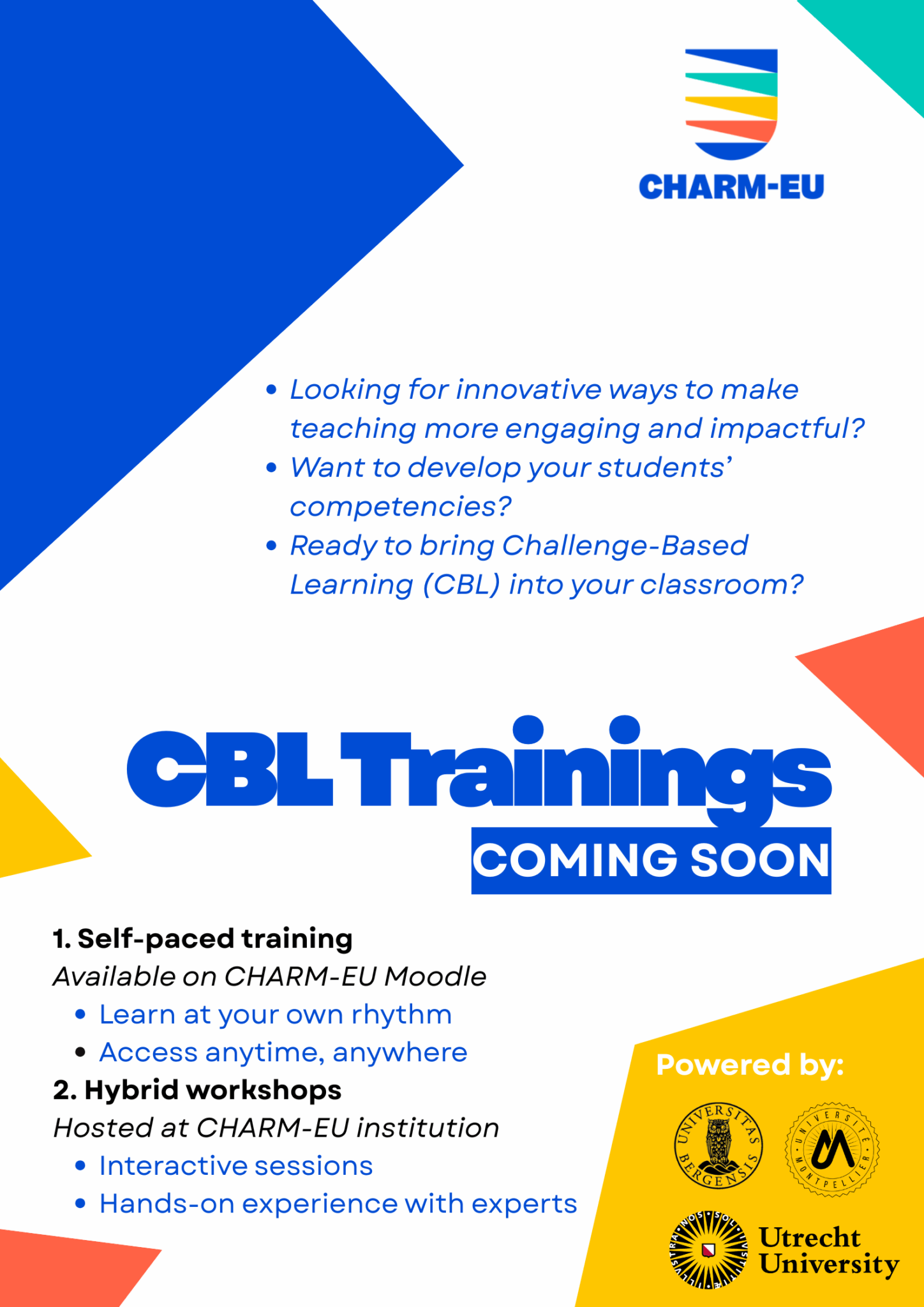
This project will redesign and develop the existing self-paced Challenge-Based Learning (CBL) course in French, originally created for Montpellier University, into a hybrid format in English that will be accessible across CHARM-EU partner institutions, in order to better align with their specific needs. It will foster collaboration among university teachers who seek to redesign their courses based on CBL principles, and will encourage co-production, peer learning, and the development of interdisciplinary perspectives through CBL-oriented practices. Unlike traditional lecture-based teaching, CBL emphasizes student-centered, real-world versatile problem-solving and interdisciplinary collaboration, requiring educators to adopt new facilitation practices.
The redesigned course will include two components:
1 Asynchronous, self-paced online modules available on the CHARM-EU Moodle hub, and
2 Synchronous hybrid training sessions featuring interactive activities delivered both online and in person.
It will incorporate CHARM-EU principles of sustainability, inclusivity, and transdisciplinarity, while providing practical tools and examples drawn from the alliance’s master’s programme. In addition, the content of this course could potentially be transformed into a MOOC and made available on an online learning platform, in order to more broadly share CHARM-EU’s advanced knowledge and experience, and to expand its impact in the field of pedagogical innovation for education for sustainable development.
A Strategic Exploration for a European Joint Degree in Communication, Information, Creativity, and Technology

More details
Dr. José Miguel Tomasena, Associate Professor of Audiovisual Communication. Faculty of Information and Audiovisual Media. University of Barcelona.
Dr. Na Fu, Chair of Responsible Leadership, Trinity Business School. Director of the Trinity AI XR Innovation Lab. Trinity College Dublin
The project aims to assess the feasibility of developing joint programs in the intersection of communication, creativity, information and technology. This initiative responds to the growing need for higher education programs that transcend the national, and disciplinary boundaries and equip students with the skills required to navigate complex, interconnected challenges in contemporary society, particularly regarding the impact of IA and other emerging technologies in sectors like communication, creative industries, media and library sciences.
The core of the proposal is a series of collaborative workshops at Trinity College Dublin and the University of Barcelona designed to engage institutional and external stakeholders in a co-creative diagnostic process. These workshops will bring together representatives from academia, policymakers civil society, and professionals from creative sectors such as journalism, audiovisual production, music, videogames, archives, libraries, and documentation, among others.
To complement these workshops, the project includes benchmarking of existing European joint programs and strategic meetings with institutional actors involved in academic planning, site visits to infrastructures.
Knowledge at Sea – Transdisciplinary Community Practices for Sustainability
More details
Laura Hellsten TD, postdoctoral researcher Polin Institute of Theological research at Åbo Akademi University
Eduardo Abrantes PhD, postdoctoral researcher Polin Institute at Åbo Akademi University.
Brigitta Czauner, PhD, hydrogeologist, Eötvös Loránd University
Álmos Levente Szőcs, educational expert of the Human-Environment Transaction Institute of Eötvös Loránd University
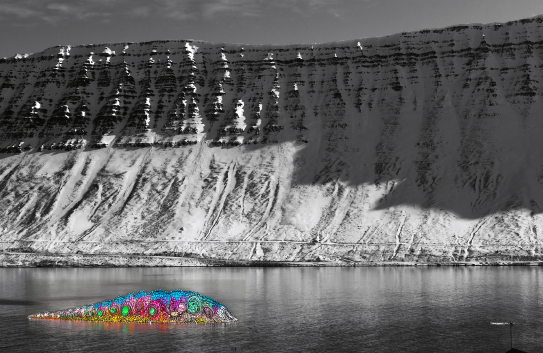
This project brings together Master students, doctoral candidates, researchers, artist and cultural workers to a transdisciplinary symposia and study trip from Turku, Finland to Ísafjörður, Iceland May 9th to 25th 2026.
We practice and develop skills and collaborations together that aim at generating new insight on sustainability issues on the topic of Sea knowledge.
CLIP Lab – Challenge-based Learning for Instrumental Protocols in Analytical Chemistry
More details
Viktor G. Mihucz, DSc, Professor of Analytical Chemistry, Eötvös Loránd University, Faculty of Science, Department of Analytical Chemistry
Szabolcs Béni, PhD, associate professor, Eötvös Loránd University
Anikó Vasanits, PhD, Eötvös Loránd University
José Garcia, DSc, University of Barcelona
Tahmer Sharkawi, PhD, associate professor and Claudia Muracciole Bich, PhD, associate professor, University of Montpellier
Johan Bobacka, DSc, Åbo Akademi University
Róbert Pál, CEO – Today Science Ltd. (Hungary)
Márta Vargha, lead expert – National Centre for Public Health and Pharmacy (NNGYK, Hungary)
Zoltán Szalai, PhD, head of laboratory – HUN-REN CsFK – Hungarian Research Centre for Astronomy and Earth Sciences
This project invites students to design and test innovative laboratory protocols in analytical chemistry that address real-world sustainability challenges. Using techniques such as chromatography, spectrometry, and electroanalysis, participants will develop cost-effective, eco-friendly methods that can be completed within short laboratory sessions. The competition emphasizes green chemistry principles, encouraging the use of solvent-free or low-toxicity approaches, waste reduction strategies, and open-source tools for data analysis. Students are also encouraged to integrate smartphone applications to enable citizen science, making advanced analytical methods accessible to the public.
By focusing on environmental samples (like water, soil, and food), plant materials, and non-invasive clinical samples, the project connects chemistry education directly to pressing issues in planetary health, food safety, and public health. The initiative is part of a broader educational effort at ELTE and CHARM-EU to promote challenge-based learning, where students engage with authentic problems, investigate solutions, and act by implementing their protocols.
Winning proposals will be recognized during ELTE’s Science Day in May 2026, and the best protocols will be published in a bilingual Practical Handbook, ensuring their legacy in future chemistry education.
Futuring MultiSpecies Aquascapes
More details
Prof. Dr. Laura Otto, Julius-Maximilians-University Würzburg
Prof. Dr. Jon Henrik Ziegler Remme, University of Bergen
Futuring MultiSpecies Aquascapes is a collaborative project that explores how humans, animals, plants, and microscopic life live together in aquatic environments such as oceans, coasts, fish farms, and even artificial water systems. At a time of climate change, rising sea levels, and growing pressure on marine and aquatic ecosystems, the project asks a simple but urgent question: how can water-based environments support life for many species, not just humans, in the future?
The project brings together researchers and master’s and doctoral students from Würzburg and Bergen to jointly develop the idea of “multispecies aquascapes,” sharing perspectives from anthropology, environmental humanities, and cultural studies. By focusing on relationships rather than single species, the project encourages new ways of thinking about sustainability, care, and responsibility in watery worlds.