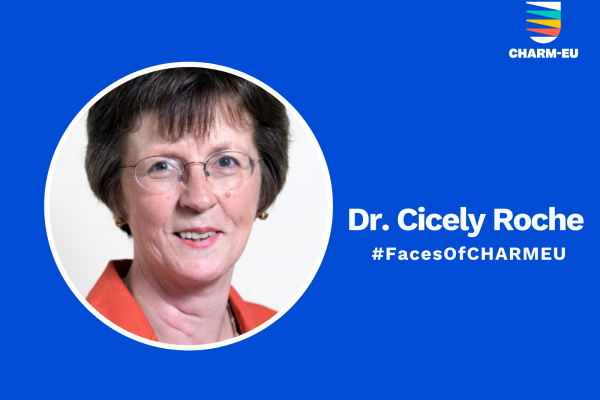
Dr. Cicely Roche, Trinity Fellow in Education for Sustainable Development at Trinity College Dublin, works in educational innovation through empowering learners to engage with complex sustainability challenges. Through her work in CHARM-EU, she is leading collaborative efforts to translate theory into teaching practice and advance Education for Sustainable Development across institutions.
Dr. Cicely Roche – Trinity College Dublin
Role: Trinity Fellow in Education for Sustainable Development (ESD), and Associate Professor in Pharmacy Practice
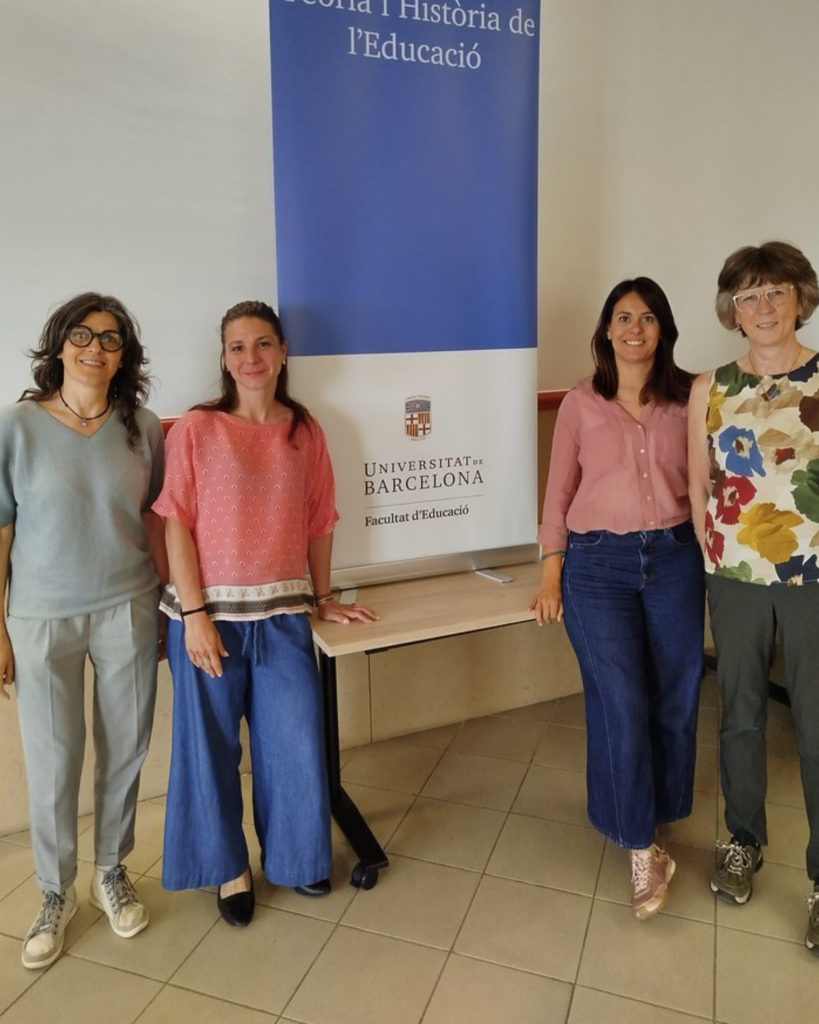
Connection to CHARM‑EU: Currently leading a CHARM-Ed Partnership between TCD, ELTE and UB titled ‘Enacting Education for Sustainable Development (ESD) in Higher Education: Guided by Theory, Grounded in Teaching Practice development’.
How did you first get involved with CHARM‑EU?
As one of six Trinity Fellows in ESD in 2023-24, working with five highly motivated disciplinary experts in various fields related to sustainable development, I became convinced that impacting positively on the climate crisis is still feasible, that increased action during this decade is essential, and that staff and students in higher education want to be agents of change right now.
CHARM-EUs educational principles align directly with the most challenging aspects of enacting ESD, and amidst pressure on the higher education sector to devote more resources to metrics and mapping, the CHARM-ED call offered a network through which the innovative teaching practices we developed could be prioritised, shared, and potentially optimised and made available to a wider network of teaching staff struggling with the ‘how’ of enacting ESD.
Your CHARM‑ED Project
What are you developing?
In partnership with Eötvös Loránd University, University of Barcelona and Trinity College Dublin, we are aiming to share and improve resources previously used for professional development related to teaching practices in ESD in Trinity to create a micro-credential format shareable across the CHARM-EU Alliance.
‘Exploring worldviews, perceptions and values’ is one of five related blocks/themes collaboratively developed by an interdisciplinary staff-student team in TCD (2023-2024). With its emphasis on the case study Mining in the Congo, as developed by student interns, it drives learners to question their worldviews, perceptions and values related to sustainability dilemmas from community, policy maker and corporate perspectives. Having experienced the workshop process as a learner, ‘Enacting ESD’ includes facilitated exploration of the theoretical underpinnings, or pedagogical approach, used in workshop design in order to further support Teaching Practice development for those enacting ESD in their own contexts.
What are the goals of your CHARM-ED project?
In order to support teaching practices that enact Education for Sustainable Development (ESD) (UNESCO, 2017: 55), our project aims to enable staff to experience, and then integrate into their teaching, the student-centred, action-oriented and transformative approaches envisaged in UNESCO’s preferred pedagogical approaches as they relate to exploring worldviews, perceptions and values in ESD.
What are those CHARM-EU educational principles that influence your project the most and why?
CHARM-EU educational principles of Sustainability and transversal skills most influence our approach.
This project aims to support teachers to acquire knowledge and develop competencies that will enable them to optimize how their teaching practices can positively impact the global aim for a sustainable society in which the planet’s finite resources and vulnerable ecosystems are preserved for current and future generations.
The content is grounded in UNESCO’s Sustainable Development Goals (SDGs), Rockstrom and Colleagues’ planetary boundaries and Kate Raworth’s Doughnut Economics shortfall dimensions. UNESCO’s sustainability competencies frame the design of learner activities, and curriculum learning outcomes target competencies development.
Transversal skills are specifically targeted in this project when, for example, learners are forced to choose from a range of less-than-ideal action options provided. Small groups must subsequently discuss, debate and negotiate to reach an agreement from their assigned perspective, in preparation for sharing their plan of action with the other groups/ perspectives.
What is the added value of collaboration with inter-institutional teams for your project?
Company on a challenging journey towards a shared objective, with others that also fundamentally believe in the potential for the ‘ripple effect’ of teaching practices to impact on this global challenge, is wonderful – and our impact on each other’s ‘worldviews, beliefs and values’ extends well beyond the constraints of the project!
In addition, the collaboration has already highlighted cultural nuances that need to be accommodated in order to deliver an effective alliance-wide micro-credential, and the multidisciplinary composition of the team repeatedly expands the range of options open to us from both academic and project management perspectives.
Vision & Future
How do you envision the impact of your joint project?
Immediate impacts include that the existing resources are shared, the relevant workshop is being trialled in the two partner Universities, and further adaptation as a CHARM-EU micro-credential is underway.
Do you think the project could be scalable in the long term?
Yes, and also in the short to medium term – this decade matters to the biodiversity and climate crisis!
How do you see the role of CHARM-EU in supporting educational innovation and collaboration?
CHARM-EU enables (and gives overt permission to take!) a curious approach to teaching practices that can address challenging ESD concepts, and scaffolds culturally diverse collaborations, in order to share and optimise novel approaches to education for sustainable development and similarly ‘wicked problems’.
The CHARM-ED Funding Call is an initiative that incentivises collaborative educational innovation projects across the alliance. It provides small-scale seed funding for academic and professional staff to collaboratively develop innovative educational activities aligned with CHARM-EU educational principles.