Let talented Master students help you to identify, investigate and address complex sustainability challenges.
The Capstone is the final phase of the CHARM-EU Master’s programme Global Challenges for Sustainability and it is designed to build on students’ knowledge, skills, and prior learning gained during the previous modules of the Master’s programme.
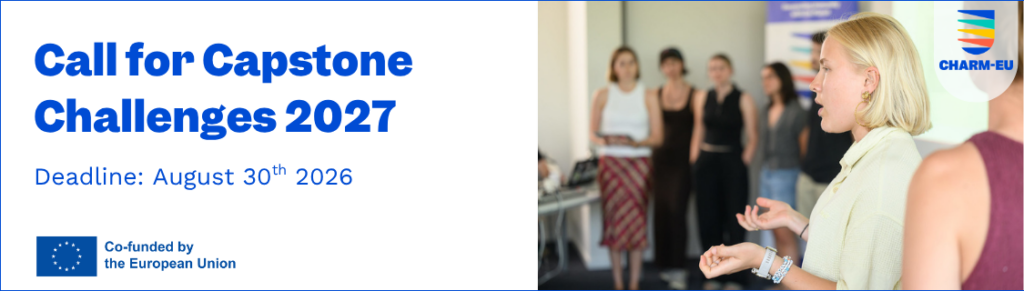
From February 2027 until June 2027, students will, in collaboration with extra-academic actors, investigate and evaluate a complex societal challenge from a variety of intercultural and transdisciplinary perspectives. They will cooperatively work on the challenge in teams of 4-5 students. Each student will focus on one aspect of the challenge, which will be the topic of an individual analysis and report. All reports will then contribute to solving the challenge. They will contribute to creatively devise, implement and evaluate robust, adaptable, ethical and sustainable solutions for complex societal challenges. These solutions can include scientific analyses; business models; policy briefs or recommendations; communication materials; or software, tools or prototypes. More information about the Capstone phase can be found in this page.
✨ Key features of the challenge:
- Students per team: 4- 5 students
- Programme: CHARM-EU Master programme Global Challenges for Sustainability
- Level: Master
- Deliverables: Individual and team-based analyses and a final Capstone report with a proposed solution
- Stakeholder time investment: about 15 hrs in total- Meetings with student team at least once a month & feedback on deliverables and presentations (online or in person)
- Free of charge
📑 Capstone Challenges
Capstone challenges focus on important societal (rather than organisational) issues related to sustainability. Challenges need to meet criteria related to interdisciplinarity, feasibility (incl. in terms of ethical procedures), scope, inclusivity and societal relevance. Most challenges focus on one or more of the countries where the 9 universities are based (Spain, The Netherlands, France, Ireland, Norway, Finland, Germany or Hungary), but can also be global in nature and/or focus on other EU or non-EU countries.
📅 Planning
- August 30th 2026: Deadline for submitting your challenge
- September 4th 2026 (or sooner): Receiving message whether your challenge is eligible
- September 20th 2026 (or sooner): Students choose challenges
- October 5th 2026 (or sooner): Matches are communicated
- Middle November 2026: Kick-off meeting with your team (online)
- February 8th 2027: Start Capstone
🏢 Benefits & requirement for participating external stakeholders
These are some of the ways in which you can benefit from being involved in the Capstone:
- Identify ways to address sustainability challenges together with students and academics.
- Receive useful outputs in the form of a final Capstone product, e.g. reports, policy briefs, infographics, business models, prototypes. The Capstone product will be co-defined by extra-academic actors, students and academic supervisors. Please note, however, that students are in the lead of their own analyses and products.
- Test or use certain technologies, software, tools, methods or equipment.
- Build competences, knowledge and skills, e.g. through mixed classrooms and workshops whereby students and professionals learn together.
- Network with other extra-academic actors, academics and students, and establish long-term collaborations with CHARM-EU and its nine partners.
- Recruit CHARM-EU students for internships/traineeships and jobs and/or help to develop knowledge and skills among (potential) future employees.
- Academics can also propose challenges, for example by linking challenges to their own research projects and thereby advance their own transdisciplinary research.
- Receive digital credential from CHARM-EU in the form of an E-Badge for hosting the challenge, more information can be found here.
✅Requirements for participating external stakeholders
External stakeholders can become engaged in the Capstone if they:
- Are active in addressing sustainability challenges that relate to (some of) the UN Sustainable Development Goals.
- Value trans- and interdisciplinary approaches and inclusiveness.
- Are willing to invest (some) time and effort in the Capstone. A stakeholder representative is expected to meet student teams at least once a month and provide feedback on the proposal, the Capstone report and the students’ presentation thereof.
- The stakeholder representative will sign a non-legally binding agreement with the student team to express commitment and availability
- The stakeholder is supposed to discuss with CHARM-EU their openness to sharing the final Capstone product in an online repository.
💰 Costs
Free of charge.
🚀 Capstone Challenges from previous editions of the Master
For information about the previous edition of the Capstone and the challenges conducted by the students and stakeholders:
📨 How to apply
You can submit the challenge directly through this website. Please provide a title of your challenge, a brief description of your challenge, and information about and/or weblinks to your organisation. In the description of your challenge, please touch on: inter-/transdisciplinarity of the challenge, how your organisation is dealing with the challenge and/or which expertise or methodology you are missing to address the challenge. Feel free to include any weblinks with further information about your challenge. Suggested number of words is max. 500.
The submission form also contains a number of questions which you need to fill out. Among those are language requirements for the student team (if any), the university you wish to align your challenge with (this is usually within the same country you are in) and preferences for data collection or methodology.
Please note that the possibility to work on your submitted challenge will depend on students’ interests, availability of academic supervisors, and division of student teams across the nine CHARM-EU partner universities. Hence, submitting a challenge does not guarantee the ability to execute it.
Questions? Want to discuss your challenge before submitting one? Please feel free to reach out to Prof. Nadja Simons, coordinator of the Capstone: nadja.simons@uni-wuerzburg.de.