Elective module: internationally linked research hubs
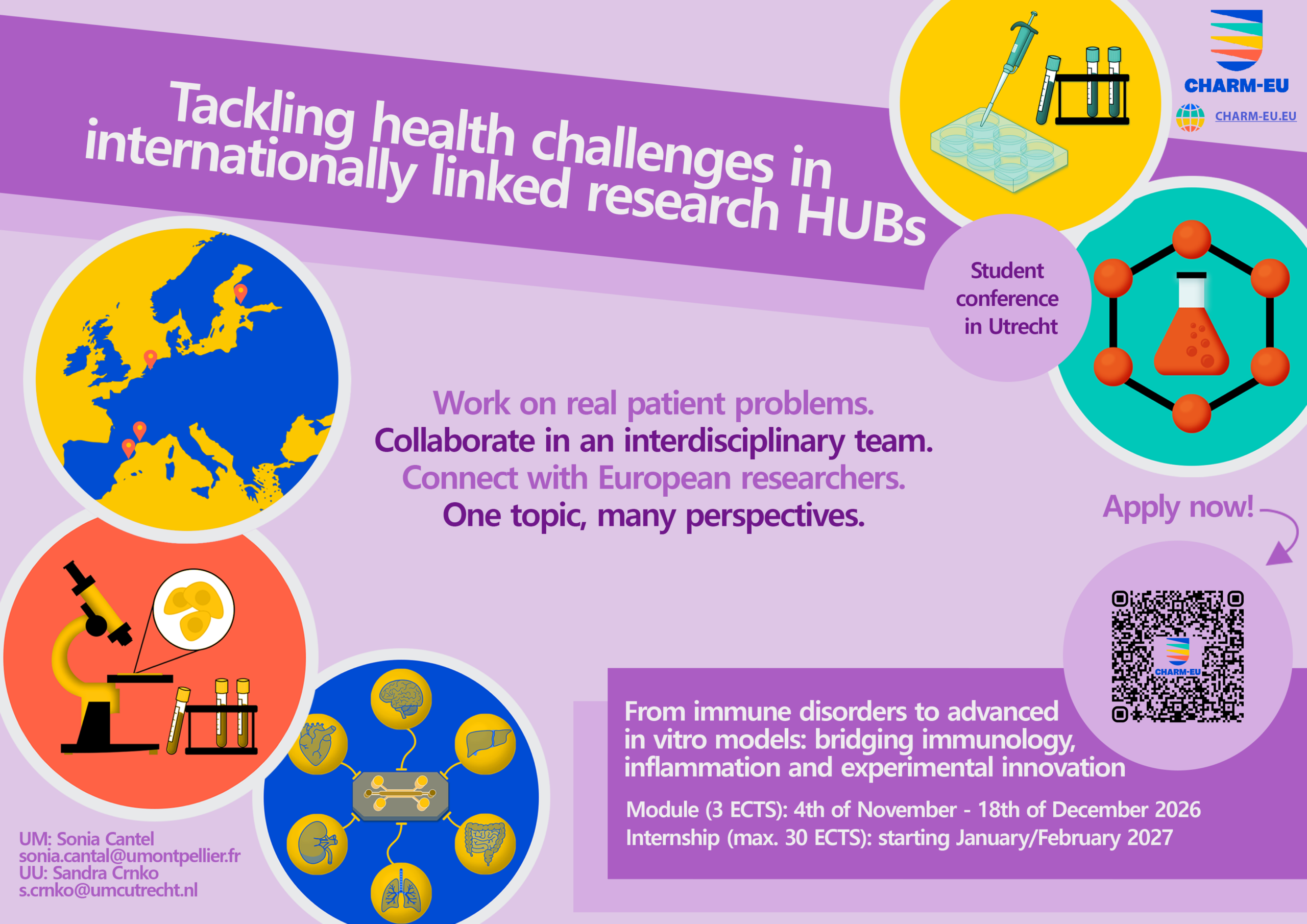
The 2026 edition of the elective module “Tackling health challenges in internationally linked research hubs” will have the theme: From autoimmunity to new approach methodologies: bridging immunology, inflammation and experimental innovation.
Master students from Université de Montpellier, Universitat de Barcelona, Abo Akademi University and Utrecht University can join in two ways:
Module: ‘Tackling health challenges in internationally linked research hubs: Framing solutions’ (4th of November – 18th of December 2026)
A part time module in which students prepare interdisciplinary research by writing a proposal for a Europeans Research Call (ERC) starting grant. The module is organised in a hybrid form between Utrecht and Montpellier. The module kicks-off with an in-person student-conference in Utrecht from the 11th to 15th of November.
Critical thinking, problem solving, communication, and collaboration skills are vital for professionals to tackle complex health challenges. Training these skills can be achieved through interdisciplinary projects where students research, prototype, and collaborate.
The linked research HUBs provide an innovative international educational platform for Master students to work together on translational medicine challenges.
Internship: 2 to 6 internationally linked positions on lab-research (Jan/Feb – June/July 2027)
A fulltime internship of maximum 6 months (max. 30 ECTS), in which students do hands-on lab research. The internship takes place in Utrecht, NL and Montpellier, FR. Positions in Barcelona, Spain and Turku, Finland still need to be confirmed. Interns will collaborate on researching the same overarching topic each from their own perspective. There are two internship positions per university.
More detailed information on the internship positions will follow on the 1st of May, 2026.
Module learning outcomes
Tackling health challenges in internationally linked research hubs: Framing solutions
The elective Master’s course offered jointly by University of Montpellier, University of Barcelona and Utrecht University fosters an international network of research hubs dedicated to addressing global health challenges with a student-centric approach. Emphasizing the cultivation of transversal skills essential for effective research, the course aims to equip students with the tools necessary to excel as researchers and prepare them for future internships and career opportunities. Students engage in interdisciplinary teamwork focused on a real-world health challenge, with the theme for the 2026/27 edition being “From autoimmunity to new approach methodologies: bridging immunology, inflammation and experimental innovation”. This theme evolves annually to address current issues. Collaborating across partner universities, students form subgroups representing diverse disciplinary backgrounds to devise hypotheses and draft research proposals aimed at addressing the chosen challenge. On-site conference at University of Utrecht is organized at the beginning of the course with representatives of various aspects of the chosen topic—including patients, patient advocacy groups, medical professionals, companies and researchers—who provide insights from their respective perspectives. Throughout the module, students participate in (hybrid) plenary workshops, skill-development lectures, and collaborative work sessions led by principal investigators from the research hubs. The culmination of the course involves the collaborative production of a written research proposal and presentation, which students pitch at the conclusion. Selected students who have participated in the course also have the opportunity to undertake up to a six-month unit internship/lab component starting in January/February 2027. On successful completion of the module students should be able to:
- Collaborate with stakeholders from different domains, disciplines, and social groups, including scientists, medical specialists, patients, society, industry, and policymakers, to design solutions to health challenges in a transdisciplinary manner.
- Develop and translate cross-sectoral, context-specific strategies/interventions within the continuum of fundamental science to pharmaceutical industry, policymaking, and social, economic, cultural, and environmental determinants of health problems.
- Demonstrate comprehensive and critical awareness of health challenges and their interconnections with One Health and Environmental & Planetary Health, including ethical approaches, personalized disease management, and societal needs.
- Formulate hypotheses based on current literature and cutting-edge data, identify appropriate methodologies.
- Analyse the principles of evidence-based translational medicine, including its application from bench to bedside and society, and vice versa.
- Summarize the key concepts and theories of the study subject, including the pathophysiology, prevention, diagnosis, treatment, and management of both communicable and non-communicable diseases with high disease burden and mortality, as well as their associated risk factors.
Internship learning outcomes
On successful completion of the internship students should be able to:
- Work full-time for 2-3 months (UB students) or 6 months (UU and UM students) on a relevant research question or patient case originating from the elective module of this course in which patients are also often involved.
- In subgroups, work together with a group of students on the same overall hypothesis using different perspectives and methodologies.
- Study the subject under the supervision of medical doctors and researchers and devise the research strategy.
- Conduct experiments to answer the research question.
- Analyse and present the data and collectively write a single scientific article or report about it.
Six students can take part in the internship (+/- 30 ECTS). There will be an exchange between Montpellier, Barcelona and Utrecht during the internship and students collaborate on the same challenge in six different internships.
Requirements
Module
The module requires a sufficient level in English speaking and writing, to facilitate the international collaboration. The lectures will be in English and the research proposal will be written in English. A mobility from UU and UB to UM will be a part of this module.
The module is open for students from:
- UM: students from the following master programs: Science du medicament, Biologie santé (cancer biology/others), Pharmacie Industrielle, Master biomolecule, Material for health
- UU: Graduate School of Life Sciences Master programs including Cancer, Stem Cells and Developmental Biology, Cardiovascular Health and Disease, Drug Innovation, Molecular and Cellular Life Sciences, Regenerative Medicine and Technology
Internship
Two students per university can take part in the internship (max. +/- 30 ECTS). An interest in interdisciplinary and international collaboration is important. The requirements for application are given under ‘how to apply?’
How to apply?
Module
Please include in the application:
- Name
- Email address
- Your current MSc programme
- Short motivation on why you want to join the module (max. 150 words)
The deadline for applying for the module is:
UU (via Osiris): August 2026
UM: 15th of September 2026
Internship
Please include in your application:
- Name
- Email address
- Current MSc programme, including completed ECTS
- Specify which internship you’re applying for
- Motivation letter of max 600 words.
- Your application for the module (it is required to participate in the 3ECTS module as a preparation for this internship).
For more information and sending in your application, you can contact the module coordinators.
- UM students: sonia.cantel@umontpellier.fr
- UU students: s.crnko@umcutrecht.nl
The deadline for applying for the internships is 15th of September 2026.
Questions about housing or mobility
If you have any questions regarding housing or mobility, please contact your local international office:
- UU students: international office UMCU
- UM students: international office UM
Schedule
Time schedule module
The module will start the 4th of November 2026 and ends on the 18th of December.
- Wed 4th of November 2026 – 13.30 to 16.30 CET
Online welcome session - Wed 11th of November to Sun 15th of November 2026 – full days onsite in Utrecht (BIP)
- 11th – Travel day + welcome to Utrecht event in the evening.
- 12th (full day) – Introductory activities, workshop on intercultural communication, workshop disciplinary dive into the conference topic with your team.
- 13th (full day) – Conference in Utrecht ‘Autoimmunity meets new approach methodologies.’ European researchers share state-of-the-art knowledge on the topic. In the afternoon students will participate in a workshop on effective grant writing.
- 14th (half day) – Meet the supervisor and interdisciplinary teamwork.
- 15th (morning) – Pitch workshop until 11.00 CET + Travel day.
- From 15th of November to 18th of December
Flexible online meetings with the teams and supervisors to write the research grant. - Wed 2nd of December 2026 – 13:30 to 16.30 CET ONSITE in hybrid classrooms
Pitch rehearsals - Wednesday, 9th of December from 9.00 to 13.00 CET ONSITE in hybrid classrooms
Grand finale: students present their pitches to a jury. - Friday 18th of December 23.59 CET: final deadline for assessments
In the weeks between the workshops, students will have self-organised team meetings, and meetings with their academic supervisor.
Time schedule internship
The internship will take place from January/February – June/July 2027.