
A joint programme requires a joint digital environment
CHARM–EU is running a joint programme, the Master ‘Global Challenges in Sustainability’. The students of this programme receive their education from academic staff at several CHARM-EU institutions simultaneously. A well-accessible joint virtual campus that everyone can access without problems is therefore crucial.
So far, this was solved via a Moodle environment hosted by Utrecht University (UU), and by providing Utrecht identities to the core teaching team. But this was both expensive and unpractical for the teaching team, who needed to juggle two identities at two different institutions.
Why Moodle? Familiar, flexible and open source
When UU recently moved to a different Virtual Learning Environment (VLE), CHARM–EU decided to remain on Moodle. Moodle is well-known to our teaching staff because it is used as primary VLE by many CHARM partners, and we have a lot of qualified experts within the alliance who know their way around Moodle. Its open source character gives us the possibility to adapt the system to our needs. Our partner university in Budapest (ELTE) took over the hosting, making it possible to re-engineer our VLE with Moodle as basis.
A VLE is more than just a Learning Management System. We also connected the assessment tool currently provided by Utrecht University and facilities for video conferencing. In this way, we are creating a modular set-up, in which we connect services provided by different partner universities, but accessed through a joint environment.

SRAM as the key to secure and seamless access
To make this possible, we made use of a service offered by SURF (the IT cooperative of Dutch education and research institutions). That service is called SURF Research Access Management (SRAM) service, more info: https://surf.nl/en/sram. Originally created for research, we wanted to see if we could use it for international education as well, and SURF has been happy to help – thank you! SRAM makes it possible to connect users from specific universities to a joint platform, giving access to specific services, while also passing on identity information about these users in the process. For example, about their role (student or teacher) and their educational affiliation (programme and cohort). These are information attributes that are necessary to give users the correct authorization level for the IT-services they use and to show them just the information that is meant for them. A crucial requirement to make this work is that all partners have an eduGAIN connection, but luckily the very large majority of European Higher Education Institutions has eduGAIN well in place.
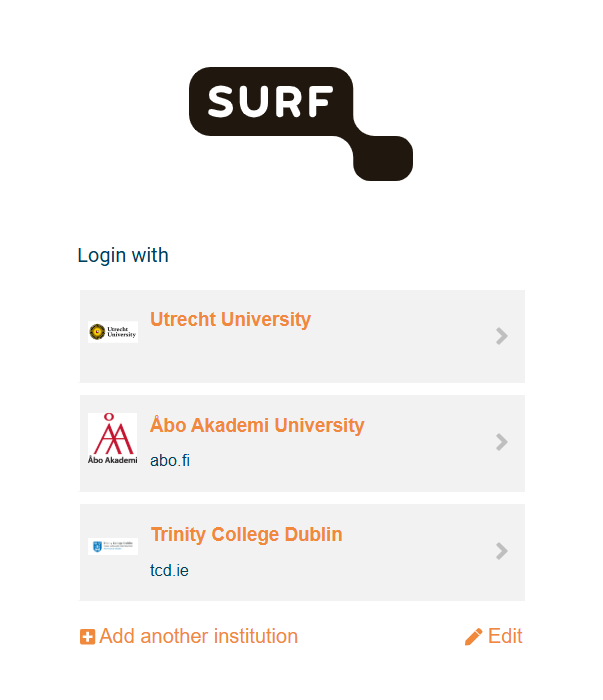
Below, see a visual of the step in the login-process to SRAM where the user identifies their home institution
Testing the system: challenges and key decisions
After successfully connecting the first two services, it was time for testing. This brought up a number of unforeseen challenges, including differences between CHARM partners with regards to Multifactor authentication processes, which turned out to impact the access procedure for some universities to SRAM. Also, we needed to think very well about how we wanted to build our authorization structure, i.e. between which roles we wanted to be able to distinguish later on.
Go-live: ready for semester two
But now, the launch is a fact. Teaching staff is preparing their material for semester 2 on the new VLE at https://moodle.charm-eu.eu. It has been optimised with new features and content such as onboarding and teacher/mentor training materials – but the biggest win is that everyone can log in with their home credentials. The team, with colleagues from Budapest, Montpellier and Utrecht, is monitoring things closely and is ready to help anyone who is running into problems. If all keeps going well, then we’ve added a nice bit of know-how to the community of Alliances about how a joint virtual campus for a joint programme can be organized.
More information: Janina van Hees j.vanhees@uu.nl